The naming of mollusks evolves at a snail’s pace -Taxonomic labels for the phylum Mollusca show Eurocentric bias and intellectual elitism-
The way scientists name and classify organisms is often seen as neutral, but it’s shaped by the cultural and intellectual traditions of the scientists themselves. A new study introduces the concept of “taxonomic Graecism,” the preference for names based on ancient Greek, and provides the first comprehensive etymological analysis covering all 773 families within the phylum Mollusca. Analysis reveals a strong dominance of Greek over Latin, particularly among European scientists, along with broader patterns such as limited use of personal names and a tendency to honor individuals from the same country. These findings suggest taxonomy reflects not only biological knowledge, but also historical biases and social structures within science.
“A rose by any other name would smell as sweet,” said Juliet Capulet in William Shakespeare’s famous play. And the same is presumably true for mollusks, albeit with different odors. When you think about the scientific names of animals, including our own species Homo sapiens, it’s tempting to see these as neutral, objective labels. But Taro Yoshimura, a researcher in evolutionary paleontology at the University Museum, the University of Tokyo, sees scientific names as time capsules that reflect the culture and education of the people who coined them. By examining the entire set of 773 molluscan family names, which includes the likes of snails, clams and octopuses, he uncovered a significant bias towards using ancient Greek, as opposed to for example, Latin. This was partly due to some ideal linguistic features of the language, but also because 19th-century European scientists used it to show off their high-level education and authority.
For Yoshimura, the seeds of this research were sown long before his professional career. “I have been an avid collector of shells since my early childhood,” he explained. “My fascination with the power of naming was truly ignited at the age of 17, when I had the opportunity to publish my first paper describing a new species. Being given the chance to coin a scientific name myself made me deeply curious about the rules and the human choices behind these labels.” This early experience evolved into a broader investigation of the historical and linguistic landscape of biodiversity.
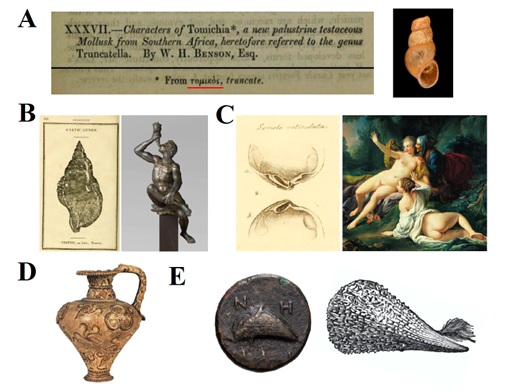
Scientific naming and Graecism in molluscan taxonomy. Various historic artifacts including text, art and materials which connect ancient Greece to naming conventions in the 18th century and beyond. ©2026 Taro Yoshimura CC-BY-ND
For more information, please see below.
UTokyo web:https://www.u-tokyo.ac.jp/focus/en/press/z0508_00450.html
関連記事
-
 Nanoscale Vesicles in Lunar Soil Particles Identified as Sites of H₂O Formation
 -
Noto quake 3D model adds dimension to understand earthquake dynamics
-
Solving the Mystery of the Color of the Aurora Borealis Appearing in Japan in May 2024 ~Analysis of photos submitted from all over Japan~
-
Aerosols involved in ice crystal formation increase with rising temperatures in the Arctic
-
Successful Observations Reveal Relationship between Shape of Pulsating Aurora and Energy of Electrons Precipitating from Geospace
-
Formation history of magnesium carbonates and chemical evolution of primitive brines on asteroid Ryugu
-
Geochemical reservoirs hidden at the bottom of the mantle discovered–Explains discrepancies in isotopic composition of Earth’s mantle and primitive meteorites
-
Asteroid Ryugu’s water-filled sources of chemical evolution and evidence of water quality metamorphism