Nanoscale Vesicles in Lunar Soil Particles Identified as Sites of H₂O Formation
-A New Solar-Wind–Driven Mechanism for Water Production Revealed, with Implications for Future Lunar Resource Utilization-
Summary
Dr. Daigo Shoji, Project Researcher at the Graduate School of Science, The University of Tokyo, has identified a new mechanism for water (H₂O) formation on the lunar surface using molecular dynamics simulations that focus on nanometer-scale voids within lunar soil particles.
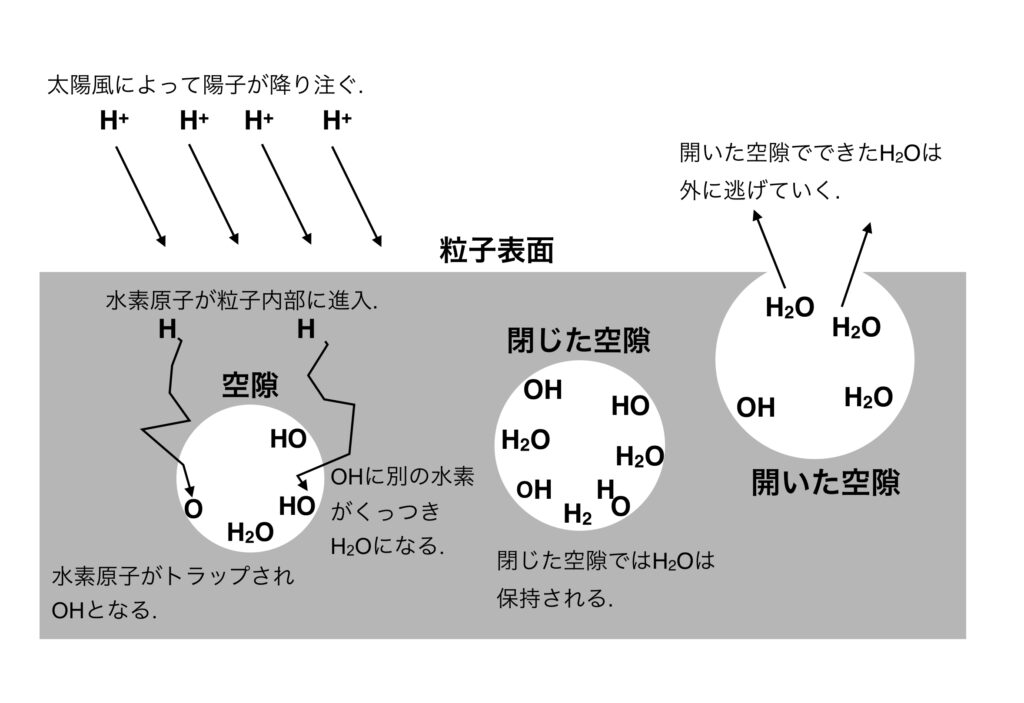
Water on the Moon has been observed in the form of hydroxyl (OH) and H₂O, with solar wind protons considered a major source. However, solar wind irradiation alone has been thought to produce only limited amounts of H₂O. This study shows that microscopic voids inside lunar soil play a key role in enhancing water formation.
The simulations reveal that decelerated hydrogen atoms (implanted protons) are efficiently trapped by oxygen atoms with dangling bonds on the walls of these voids, leading to a high number density of OH groups. This increased local concentration promotes the formation of H₂O molecules. Simulations assuming plagioclase (anorthite) indicate that solar wind exposure equivalent to several lunar days can generate relatively large amounts of H₂O—up to several weight percent—around the voids, without requiring additional processes such as micrometeorite impacts.
The study also suggests that H₂O formed in open voids connected to the exterior may escape and migrate to colder regions, where it could accumulate as ice, while water in closed voids remains trapped within the soil.
These findings provide new insights into how water is generated and stored on the Moon and have important implications for future human lunar exploration and the use of lunar water resources.
For more information, please see below.
School of Science, UTokyo: https://www.s.u-tokyo.ac.jp/en/press/11048/
関連記事
-
 The naming of mollusks evolves at a snail’s pace -Taxonomic labels for the phylum Mollusca show Eurocentric bias and intellectual elitism-
 -
Noto quake 3D model adds dimension to understand earthquake dynamics
-
Solving the Mystery of the Color of the Aurora Borealis Appearing in Japan in May 2024 ~Analysis of photos submitted from all over Japan~
-
Aerosols involved in ice crystal formation increase with rising temperatures in the Arctic
-
Successful Observations Reveal Relationship between Shape of Pulsating Aurora and Energy of Electrons Precipitating from Geospace
-
Formation history of magnesium carbonates and chemical evolution of primitive brines on asteroid Ryugu
-
Geochemical reservoirs hidden at the bottom of the mantle discovered–Explains discrepancies in isotopic composition of Earth’s mantle and primitive meteorites
-
Asteroid Ryugu’s water-filled sources of chemical evolution and evidence of water quality metamorphism