Space Strategy Fund (2nd Phase) Approval granted for “Elemental technology for lunar surface infrastructure”
-Establishment of exploration technologies for water and metallic elements as lunar resources-
Summary
The University of Tokyo (Headquarters: Bunkyo-ku, Tokyo; President: Teruo Fujii) has been selected for the “Technology Development Themes/Exploration, etc. (Elemental technology for lunar surface infrastructure)” under the “Space Strategy Fund (2nd Phase)” publicly solicited by the Japan Aerospace Exploration Agency (JAXA). (Project Title: “Development of a Flight Model for Water and Metal Element Exploration Equipment and Actual Measurement of Lunar Resource Quantities”). In this project, the grant has been approved on February 10, 2026. The ‘LUNAR-RABBIT Project’ is now launched.
Countries around the world are planning exploration activities aimed at establishing sustainable operational bases on the Moon (e.g., the Artemis program by the U.S.). One of the greatest challenges in building infrastructure for future human activities on the Moon is the high cost associated with transporting supplies from Earth. To overcome this challenge, establishing technologies to locally procure resources present on the Moon, such as water and metallic elements, is essential. This project will develop four observation devices capable of measuring the concentration and mineral composition of elements expected to be lunar resources directly on the lunar surface. It will conduct resource exploration on the Moon and acquire resource data. The four observation devices that this team will develop are a wide-angle spectroscopic camera, a neutron/gamma-ray sensor, a laser-induced plasma emission spectrometer, and a microscopic spectroscopy camera. By combining these components, we aim to demonstrate a unique observation method capable of discovering resource elements, evaluating their concentration and total quantity, and even identifying their presence forms, such as “which elements are concentrated in which minerals” (Figure 1).
Furthermore, this observation system is expected to contribute to acquiring lunar environmental data, such as geological and soil characteristics and radiation environments, which will be essential for planning future human lunar activities and lunar base construction.
To advance this project, an industry-academia collaboration team (*) has been formed. It centers on researchers with experience in developing observation instruments for planetary exploration missions like Hayabusa2 and SLIM, and includes companies with extensive experience in the space sector and in possessing ground sensor technologies. This team will also contribute to strengthening the technological foundation for future lunar development and expanding the base of related fields.
The following members from the Department of Earth and Planetary Sciences, Graduate School of Science are participating: Associate Professor Tomokatsu Morota, Assistant Professor Yuichiro Cho, Postdoctoral Research Fellow Daigo Shoji, Associate Professor Kazuo Yoshioka (who is also an associate professor in the Graduate School of Frontier Sciences), Associate Professor Yayoi Miura (who is also an associate professor in the Earthquake Research Institute), graduate student Hikaru Hyuga, Professor Seiji Sugita, and from the Office of Research Strategy and Development, Associate Professor Yoshiko Baba.
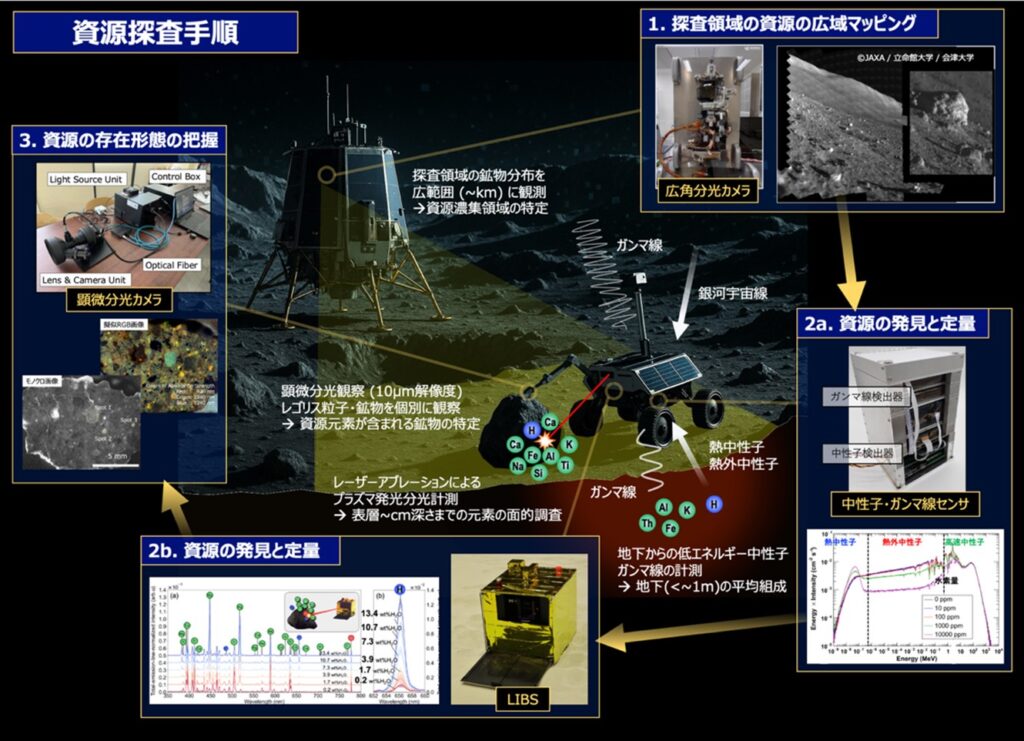
Figure 1: Conceptual image of resource exploration using the developed observation devices. The team will establish a resource exploration procedure leveraging the characteristics of the four observation devices: (1) Wide-area resource mapping of the exploration region and identification of resource-rich areas using a wide-angle spectroscopic camera, (2) Evaluation of resource element concentrations from the surface to a depth of 1 m using neutron/gamma-ray sensors and a laser-induced plasma emission spectrometer (LIBS), (3) Determination of resource presence forms using a microscopic spectroscopic camera.
For more information, please see below.
School of Science, UTokyo: https://www.s.u-tokyo.ac.jp/en/info/11065/